Orbit Guide
In Orbit you control a character that keeps circling a planet while meteors and other hazards fly in, and the goal is to survive as long as possible. The character follows a fixed circular orbit on its own; the only thing you can do is reverse direction. Everything comes down to when you flip, so it is simple, but your hands get busier the longer you last.
Gameplay video

A YouTube Short of real Orbit gameplay. Tap the thumbnail to play it right here on this page. Watching the flow first and then reading the controls and tips below is the quickest way to get the hang of it.
Controls
| Device | How to play |
|---|---|
| Phone / tablet | Tap anywhere on the screen to reverse direction. |
| PC | Press Space, Enter or any arrow key, or click the screen, to reverse direction. |
The character never stops. It either keeps circling one way or turns back when you tap. To stay around the same spot, tap several times quickly to wiggle back and forth.
Score and speed
Your score is how long you survive. It is shown in the top-left corner to a tenth of a second and saved to the leaderboard in seconds. Over time the character circles faster and meteors arrive more often and faster. Both the orbit speed and the meteor rate peak after a little over three minutes (about 190-200 s). A bar under the stage name shows how close the next stage is, and skimming past a meteor pops up a "Close!" message.
Screenshots
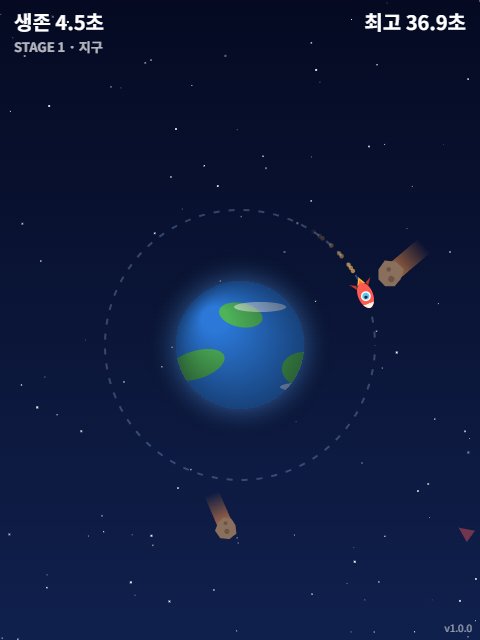
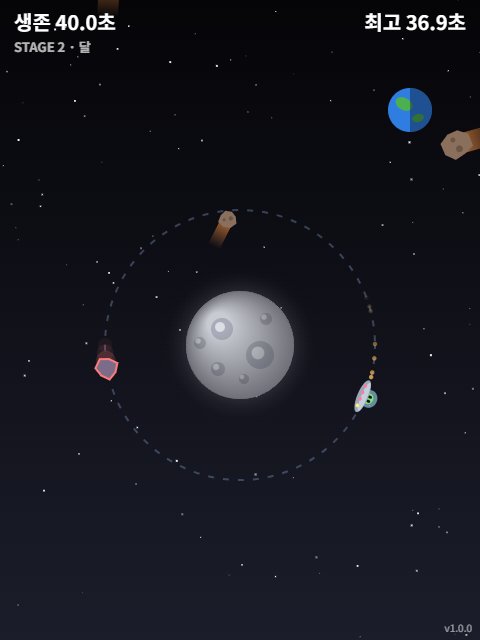
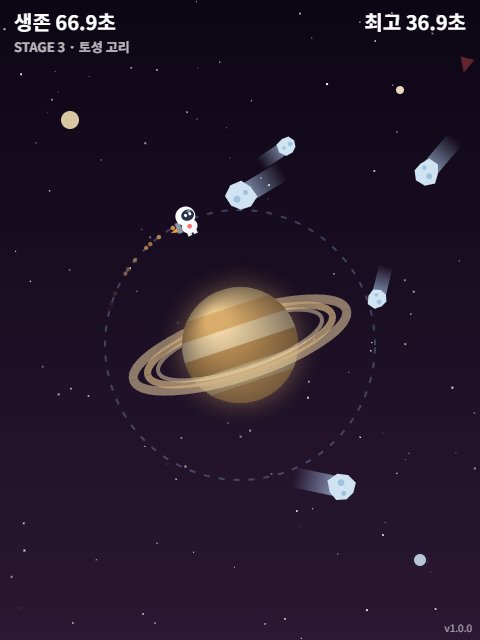
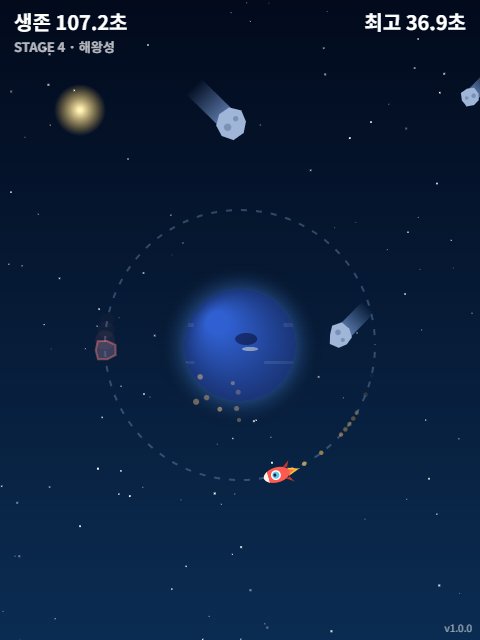
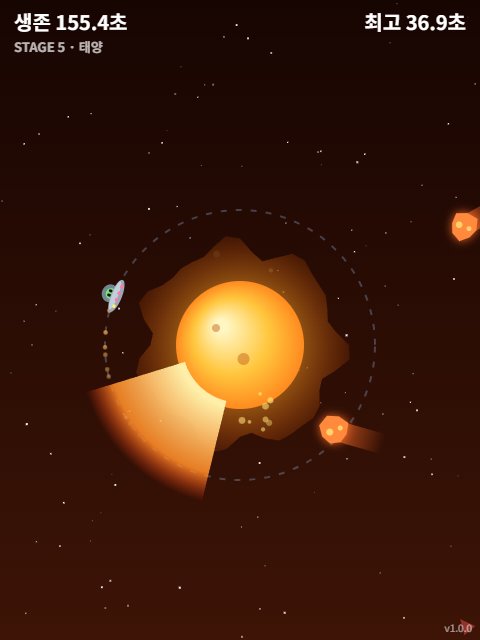
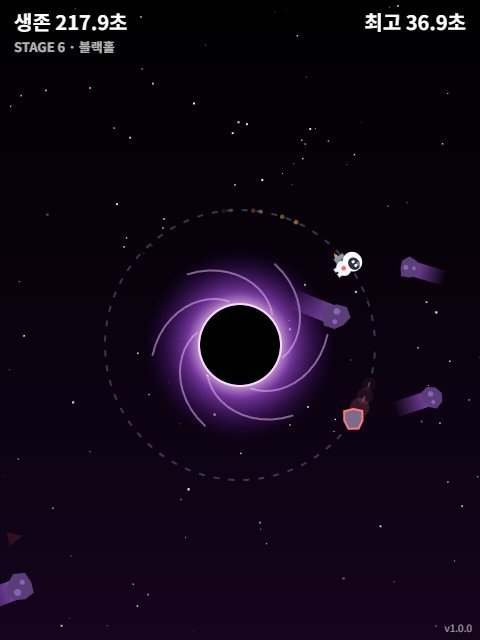
Stages
Survive for a set time and you move on to the next stage, as the body in the center and the background slowly change. Most hazards from earlier stages keep appearing, and each stage adds one new one.
| Stage | Starts at | What is new |
|---|---|---|
| 1 Earth | 0 s | Meteors flying straight in from off screen |
| 2 Moon | 30 s | Orbit rocks that travel along your orbit |
| 3 Saturn's Rings | 60 s | Ice meteors sometimes come in pairs, and orbit rocks get a little faster and more frequent. |
| 4 Neptune | 100 s | Fast comets with long tails are mixed in. |
| 5 Sun | 150 s | Solar flares that burn a section of the orbit. In exchange there are slightly fewer meteors and no orbit rocks. |
| 6 Black Hole | 210 s | Meteors curve as gravity pulls them in. Orbit rocks return too. |
How to handle each hazard
Meteors
Meteors fly straight from off screen toward the planet and cross your orbit. Before one enters the screen, a red arrow on the screen edge shows where it is coming from. When you see an arrow, guess where the meteor will cross your orbit and flip early so you do not arrive there at the same time. A meteor that hits the planet disappears in a puff of dust.
Orbit rocks (from the Moon)
Orbit rocks travel along the same orbit as you and close in. For about 1.2 seconds after appearing they are see-through and blinking, and touching them then is harmless. Once they turn solid they are dangerous, so turn your back to the rock and move away. Rocks vanish after a few seconds, so running the other way to buy time is the basic plan. Because the orbit is a circle, running too far one way brings you back to the rock from the other side, so stay close and keep your distance by moving back and forth.
Comets (Neptune)
Comets are smaller than normal meteors but about 1.4 times faster, with a long light-blue tail. They arrive soon after the red arrow appears, so on Neptune react the moment you see an arrow.
Solar flares (Sun)
A flare first marks a section of the orbit with a blinking red dotted line. The warning lasts about 1.5 seconds; when the orange line inside fills up, that section burns for 0.7 seconds. If you are inside it while it burns, the game ends. The warning always starts away from your character, so turn so you do not enter the warned section and wait on the other side.
Curving meteors at the Black Hole
In the Black Hole stage, meteors bend as they are pulled toward the center. If you trust only the direction you first see, they curve farther in than expected and hit you. Assume they will bend toward your orbit as they get close, and give them a bit more room.
Characters
The three characters differ only in looks and the sound they make when turning. Size and hitbox are the same.
| Character | Description |
|---|---|
| Rocky | A tiny red rocket blasting flames from behind |
| Ufo | A green alien's flying saucer with lights spinning underneath |
| Starry | An astronaut in a round helmet flying with a jetpack |
Tips for surviving longer
- Flip one beat early - turning when a meteor is right in front of you is too late. Watch the arrows and flip ahead of time.
- Do not save your taps - there is no limit or penalty for turning. In tight moments, tapping quickly to hover in place is the safest move.
- Watch two hazards at once - from the Moon onward, orbit rocks and meteors come together. When you run from a rock, check that no meteor is crossing the way you are heading.
- Be careful right after a new stage - a new hazard can appear immediately. When the STAGE banner shows at the top, stay calm and look around.
Leaderboard
When the game ends you can enter a nickname to save your time, and the top 20 are shown on the leaderboard in seconds. Your personal best is saved in your browser. The server rejects any survival time longer than the time that has actually passed since you started, so records can only come from real play.
Other guides: Jump Runner · Fish Dodge · Sky Climb · Neon Shooter · Making-of notes